
CLIENT
Enterprise Telecom Platform · B2B
FOCUS
UX strategy, IA, interaction design, design system; desktop-first
ROLE
Senior Product & UX Designer
TEAM
Product Owner, Senior Product & Service Designer, Solution Architect, Developers
DURATION
November 24 – March 25
TOOLS
Figma, Confluence, Miro
Overview
The platform was a legacy network management system used by telecom operators to monitor, maintain and troubleshoot large-scale network infrastructure.
Over many years it had become increasingly difficult to navigate, creating inefficiencies for both customers and internal teams. My assignment was to lead the UX strategy and redesign to improve usability, scalability and product adoption.
Challenges
The existing platform suffered from years of accumulated complexity. Users struggled to navigate the system; onboarding was slow and required extensive training and support. Meanwhile the business wanted to increase scalability through automation and modular product offerings.
Key challenges
-
Complex navigation and high cognitive load
-
Workflows that did not match users’ mental models
-
Limited scalability due to legacy information architecture
-
No consistent design system
-
Heavy dependence on manuals and support teams
-
Conflicting expectations between business stakeholders and end users
-
Accessibility gaps and inconsistent UI patterns
My Role
As the lead designer, I owned the end-to-end UX process from discovery through validation and delivery; strategy and discovery, stakeholder and user interviews, workshop facilitation, IA, interaction design, prototyping, design system creation, usability testing, accessibility, and cross-functional collaboration across Product, Sales, Marketing and Engineering.
Discovery & Define
The goal was to understand user needs, identify pain points and align the team around product vision and priorities.
Key finding
Three functional areas emerged as critical to users' daily work: inventory management, firmware upgrades and troubleshooting. These had initially been considered for modular packaging and separate sales, but research showed users relied on all three as part of one continuous workflow. Splitting them would have introduced friction and reduced the overall experience.
The challenge was not only functional, it was about trust. Engineers feared automation would mean losing visibility, control and professional expertise.
I facilitated workshops across Product, Sales and Marketing to align positioning. The messaging shifted from replacing expertise to empowering users with better control, efficiency and decision support.
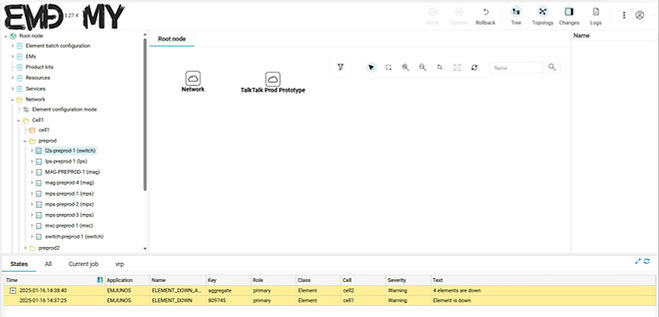
Before: the legacy management system

Ideate & prototype
This phase explored solutions, defined improved workflows and created prototypes for validation and testing.
Key finding
Architectural dependencies in the existing system significantly limited changes to the navigation structure. Operation tables were closely tied to the legacy tree navigation, making large-scale restructuring difficult without disrupting established user behaviour, improving usability while keeping enough familiarity for existing users.
Design focus
-
Clearer navigation and industry-standard terminology
-
Progressive disclosure to reduce cognitive load
-
Iterative sketching and prototyping with long-time users

Establishing a design foundation in Figma

Reusable components in the design library
Validation & delivery
The final phase validated the proposed solutions, measured usability outcomes and prepared assets for implementation, usability testing with existing and potential new users, task-success measurement, WCAG 2.1 AA validation, design-library delivery in Figma and developer handoff.


Redesigned dashboards
Impact & results
Faster
Significantly reduced onboarding time in usability testing
Self-serve
Users completed core tasks without relying on manuals
Trust
Increased user confidence and control
Business impact
-
Reduced friction during sales and evaluation phases
-
Clearer product positioning and improved adoption
-
Faster future development through a scalable component library
-
Reduced dependency on support teams after implementation
Reflections & learnings
-
Early alignment between design, technology and marketing is critical
-
Legacy environments require planning for migration early
-
Cross-functional cooperation creates shared understanding of user and business needs