
The Challenge
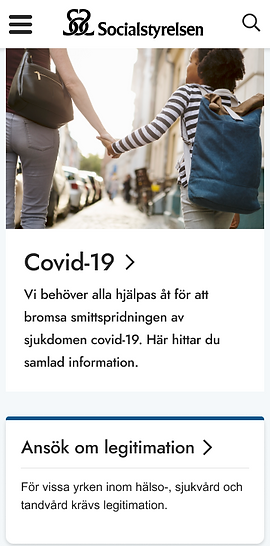
Socialstyrelsen needed to modernise its national web platform to better support healthcare professionals, administrators and strategists.
The challenge was to restructure a large, complex content ecosystem while ensuring high accessibility standards, regulatory compliance, and clarity across diverse user groups.
My Role
I led UX research and UX/UI design in a cross-functional team, acting as the bridge between users, content owners, developers and stakeholders.
Key responsibilities:
-
UX research (user interviews, usability testing, workshops)
-
Information architecture & navigation design
-
Interaction design and prototyping
-
Accessibility strategy (WCAG 2.1 AA, DOS Act)
-
Design system & style guide updates


Research activities
Research was conducted with healthcare professionals, strategists, administrators and social service representatives through usability testing, interviews and structured workshops.
Key Insights
-
Search is the primary entry point – users often arrive via Google and rely heavily on search to navigate complex content.
-
Navigation and content structure were difficult to scan, especially for time-constrained professionals.
-
National Guidelines were the most critical content, but were hard to locate and understand due to naming, hierarchy and visual affordances.
-
Clickable elements were not perceived as interactive, causing missed content.
-
Accessibility issues affected both usability and trust, particularly for visually impaired users.
Design & Solutions
Design focus areas
1. Navigation & information architecture
-
Reworked main navigation and content groupings
-
Reduced cognitive load and duplication
-
Improved orientation and sense of place
2. Search & findability
-
Clarified search results structure and filtering logic
-
Improved distinction between content types (pages, documents, data)
3. Visual hierarchy & interaction clarity
-
Improved affordances for clickable elements
-
Clearer hierarchy for text-heavy pages
4. Accessibility & design system
-
Updated typography, contrast and components to meet WCAG 2.1 AA
-
Strengthened consistency through design system updates


Impact & Outcome
-
Improved usability and navigation across the national platform
-
Increased user satisfaction, especially for visually impaired users
-
Strengthened accessibility, performance, SEO and responsiveness
-
Delivered a future-proof foundation for continued digital development
Learnings
This project reinforced the importance of observing user behaviour beyond what users say, especially in high-stakes, information-dense environments.
Designing for accessibility at this scale is not a constraint — it is a quality driver that improves clarity, trust and usability for everyone.
.png)
.png)